Galvanized Pipe Problems in Older Washington, DC Homes
Learn about galvanized pipe problems in older Washington, DC homes, including corrosion, low water pressure, leaks, repair options, replacement costs, and warning signs.
Galvanized Pipe Problems in Older Washington, DC Homes
Older homes in Washington, DC can have plumbing systems that have served families for decades. One material you may encounter in these properties is galvanized steel pipe.
Galvanized pipes were commonly used in residential plumbing before modern copper, PVC, CPVC, and PEX systems became more common. The zinc coating was intended to protect steel from corrosion, but that protection does not last forever.
As galvanized pipes age, corrosion can build up inside the pipe. The result can be gradually declining water pressure, discolored water, leaks, and eventually pipe failure.
If you own an older Washington, DC home and are experiencing recurring plumbing problems, determining whether galvanized piping is present can help explain why those problems keep returning.
What Are Galvanized Pipes?
Galvanized pipes are steel pipes coated with a layer of zinc.
The zinc coating was designed to slow corrosion and extend the useful life of the steel. Galvanized steel was widely used for water-supply plumbing in older residential and commercial buildings.
The problem is that galvanized steel can eventually corrode from the inside.
Over many years, rust and mineral deposits can accumulate inside the pipe. The opening through which water flows becomes progressively smaller.
A pipe that originally provided good water flow may eventually become severely restricted.
Why Were Galvanized Pipes Used in Older Homes?
Galvanized steel was historically attractive because it was durable, relatively strong, and resistant to corrosion when new.
It was commonly used for:
- Cold-water supply lines
- Hot-water supply lines
- Residential plumbing
- Commercial plumbing
- Exterior water piping
- Building water distribution
The issue isn't that galvanized pipe was necessarily poorly designed when installed. The concern is age and deterioration.
A galvanized plumbing system that has been in service for many decades may be approaching or exceeding its practical service life.
What Problems Do Galvanized Pipes Cause?
Reduced Water Pressure
One of the most common symptoms is declining water flow.
As corrosion accumulates inside galvanized pipes, the internal passage becomes narrower.
You may notice:
- Weak shower pressure
- Slow-filling toilets
- Weak faucet flow
- Poor flow from multiple fixtures
- Pressure that gets worse over time
If several fixtures throughout the house have low flow, deteriorated galvanized piping is worth investigating.
Rust-Colored or Discolored Water
Brown, yellow, or rusty-looking water can occur when corrosion products enter the water.
Discoloration may be especially noticeable after water has been sitting in the pipes for several hours.
However, discolored water can have other causes, including utility work or disturbances in the water distribution system. It should not automatically be attributed to galvanized plumbing.
Frequent Leaks
As corrosion progresses, galvanized steel can become increasingly vulnerable to leaks.
You may see:
- Damp spots
- Rust around pipe joints
- Water stains
- Small drips
- Corroded fittings
- Repeated pipe repairs
A pipe that has developed multiple leaks may indicate a broader deterioration problem rather than one isolated failure.
Pipe Breaks
Severely deteriorated galvanized pipe can eventually fail.
A small leak may develop into a larger opening, particularly around threaded connections or heavily corroded sections.
Clogged or Restricted Pipes
Corrosion can reduce the usable diameter of the pipe.
In severe cases, the pipe may become heavily restricted internally.
This can make the plumbing system feel as though the home's water supply is weak even when the incoming water pressure is adequate.
How Can You Tell If Your Home Has Galvanized Pipes?
There are several clues.
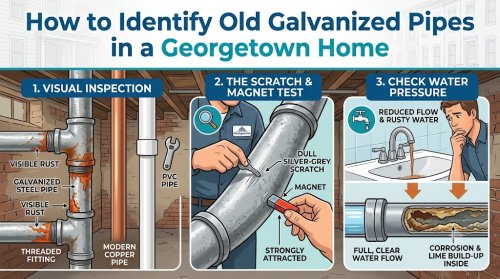
Look at Exposed Pipes
Galvanized steel pipes are typically gray or silver-colored.
Older galvanized piping may show:
- Gray metal surfaces
- Rust
- Threaded connections
- Corrosion around joints
- Flaking or rough surfaces
A magnet may stick to galvanized steel because it has a steel core, although a magnet alone cannot reliably identify every plumbing material.
Check Accessible Plumbing Areas
Look in areas such as:
- Basements
- Utility rooms
- Mechanical rooms
- Crawl spaces
- Areas beneath sinks
- Near water heaters
Do not remove insulation or disturb plumbing simply to identify the material.
Ask About the Property's Plumbing History
Previous owners may have replaced portions of the original plumbing.
This means a house may have a mixed plumbing system, with galvanized steel in some areas and copper, PEX, or other materials elsewhere.
A plumber can identify accessible pipe materials and determine how much of the system appears to be galvanized.
Why Do Galvanized Pipes Corrode?
Internal Corrosion
Water continuously contacts the inside of the pipe.
Over time, corrosion can develop on the steel beneath or around the protective zinc coating.
Age
The older the plumbing system, the more opportunity corrosion has had to develop.
Water Chemistry
Water chemistry can influence how plumbing materials behave over time.
Threaded Connections
Galvanized pipes are commonly joined using threaded fittings. These connections can become vulnerable to corrosion and leakage as the system ages.
Previous Repairs
Repeated repairs can create a patchwork system where some newer sections connect to severely deteriorated original pipe.
Replacing one failed section does not necessarily mean the remaining galvanized plumbing is in good condition.
What Are the Warning Signs of Deteriorating Galvanized Plumbing?
Pay attention to these symptoms:
- Low water pressure
- Rust-colored water
- Repeated leaks
- Visible corrosion
- Rust around pipe fittings
- Weak shower flow
- Slow fixture filling
- Noisy pipes
- Water stains
- Frequent plumbing repairs
- Leaks that keep appearing in different areas
The combination of low water pressure and old galvanized piping is particularly worth investigating.
Can Galvanized Pipes Affect Water Quality?
Galvanized pipes can deteriorate and release corrosion products into the water.
However, water discoloration does not automatically mean the water is unsafe to drink.
Washington, DC maintains water-quality information and publishes annual drinking-water-quality reports. If you are concerned about water quality, review current information from DC Water and consider appropriate water testing rather than relying solely on the appearance of the water.
If water suddenly becomes discolored, especially following utility work or a water-main disturbance, check for local DC Water notices before assuming the plumbing inside your home is responsible.
Can You Repair Galvanized Pipes?
Yes, individual sections can sometimes be repaired or replaced.
The right approach depends on the condition of the existing plumbing.
Minor Localized Repair
If one accessible fitting has failed and the surrounding pipe is in good condition, a plumber may be able to replace that section.
Section Replacement
A deteriorated section can sometimes be removed and replaced with a compatible modern material.
Larger Replacement
If multiple sections are corroded, replacing individual leaks one at a time may become increasingly impractical.
In that situation, a plumber may recommend replacing larger portions of the water-supply system.
Should You Repair or Replace Galvanized Pipes?
This is one of the most important questions for an older homeowner.
Repair May Make Sense When:
- The problem is isolated.
- Most of the accessible piping appears sound.
- The pipe is reasonably accessible.
- There are no significant flow restrictions.
- The repair can be completed without creating compatibility problems.
Replacement May Make More Sense When:
- Multiple leaks are occurring.
- Water pressure is consistently poor.
- Pipes are heavily corroded.
- The system requires frequent repairs.
- Corrosion is visible throughout accessible areas.
- The plumbing has reached an advanced stage of deterioration.
- You are already performing a major renovation.
The goal should be to choose the solution that makes sense for the condition of the entire plumbing system, not simply the pipe that happens to be leaking today.
Can You Replace Galvanized Pipes Yourself?
Small plumbing repairs may be appropriate for experienced homeowners, but whole-house pipe replacement is generally not a beginner DIY project.
It can involve:
- Cutting existing pipe
- Removing threaded connections
- Working with pressurized plumbing
- Connecting different pipe materials
- Accessing walls and ceilings
- Testing the completed system
- Meeting applicable plumbing requirements
Improper connections can cause leaks and additional property damage.
For significant plumbing work, use an appropriately licensed plumbing professional and verify current District requirements.
How Does a Professional Inspect Galvanized Plumbing?
Step 1: Property and Plumbing History
The plumber asks about the home's age, previous plumbing work, recurring leaks, pressure problems, and water discoloration.
Step 2: Visual Inspection
Accessible piping is examined for corrosion, leaks, repairs, and material type.
Step 3: Water-Pressure Testing
Pressure is measured to determine whether low flow is actually associated with a pressure problem.
Step 4: Flow Assessment
The plumber compares water flow at multiple fixtures.
Step 5: Leak Investigation
If water loss is suspected, the plumber checks for visible and concealed leaks.
Step 6: Evaluate the Overall System
The plumber determines whether problems appear isolated or widespread.
Step 7: Explain Repair Options
The homeowner should receive an explanation of repair versus replacement options before major work begins.
What Tools Can Plumbers Use?
Depending on the problem, a plumber may use:
- Water-pressure gauges
- Pipe inspection cameras
- Leak-detection equipment
- Moisture meters
- Pipe locators
- Thermal imaging
- Flow-testing equipment
Not every tool is necessary for every galvanized-pipe problem.
The purpose of professional equipment is to reduce guesswork and help identify the actual source of the plumbing problem.
How Long Does Galvanized Pipe Replacement Take?
There is no single timeline.
Small Repair
A straightforward exposed-pipe repair may be completed relatively quickly.
Partial Replacement
Replacing several sections may take longer depending on access and the amount of deteriorated piping.
Whole-Home Replacement
A larger repiping project can take significantly longer because plumbers may need access to walls, ceilings, floors, and utility areas.
The property layout, number of fixtures, pipe accessibility, permits, material selection, and extent of deterioration all affect the schedule.
How Much Does Galvanized Pipe Replacement Cost?
Avoid plumbers who give you a universal price without seeing the plumbing system.
Costs can vary according to:
- Amount of pipe being replaced
- Pipe material selected
- Labor
- Accessibility
- Number of fixtures
- Wall or ceiling access
- Property size
- Permit requirements
- Disposal of old materials
- Emergency service
- Repair versus full repiping
- Local labor rates
A small basement repair and a whole-house repiping project are completely different jobs.
Ask for a written explanation of the recommended work and what is included in the estimate.
Hidden Truths Homeowners Should Know
One Leak May Not Be the Only Problem
When an older galvanized pipe develops one significant leak, the surrounding system may also be deteriorated.
Repeated Spot Repairs Can Add Up
Repairing one leak at a time can eventually cost more than addressing widespread deterioration.
Low Water Pressure May Be a Pipe Problem
Replacing a showerhead will not fix severely restricted galvanized supply piping.
New Plumbing Does Not Automatically Mean the Entire System Is New
Older homes often contain a mixture of original and newer plumbing.
Pipe Material Matters
Different plumbing materials have different installation requirements and characteristics. Connections between dissimilar materials need to be made correctly.
A Plumbing Inspection Is More Useful Than Guesswork
Before deciding to repipe a property, determine the actual condition of the existing plumbing.
15 Common Mistakes Homeowners Make
1. Ignoring Rust-Colored Water
Recurring discoloration deserves investigation.
2. Treating Every Leak as an Isolated Problem
Multiple leaks may indicate systemic deterioration.
3. Replacing Only the Faucet
A faucet cannot correct restrictions in the supply piping.
4. Ignoring Low Water Pressure
Gradually declining pressure may be a warning sign of internal corrosion.
5. Waiting for a Major Pipe Failure
A planned replacement is generally less disruptive than an emergency repiping project.
6. Mixing Plumbing Materials Incorrectly
Improper connections can lead to premature failures.
7. Over-Tightening Fittings
Excessive force can damage threaded plumbing connections.
8. Using Temporary Sealants as Permanent Repairs
A patch may hide the problem without addressing deteriorated pipe.
9. Replacing One Section Without Inspecting Nearby Pipes
The surrounding plumbing may be in similar condition.
10. Cutting Into Walls Without a Plan
Unnecessary demolition increases costs.
11. Choosing the Cheapest Estimate Automatically
The lowest initial estimate may not address the underlying problem.
12. Ignoring Water Pressure Changes
A pressure change can indicate a restriction or leak.
13. Skipping Preventive Maintenance
Older plumbing benefits from periodic inspection.
14. Waiting Until a Renovation Is Finished
If plumbing replacement is likely, plan it before closing walls or ceilings.
15. Hiring Someone Without Verifying Qualifications
Major plumbing work should be performed by an appropriately licensed professional.
Maintenance Tips for Homes With Older Plumbing
If your Washington, DC home contains galvanized piping, consider:
- Inspecting exposed pipes periodically.
- Looking for rust around threaded joints.
- Monitoring water pressure.
- Watching for recurring leaks.
- Checking under sinks.
- Inspecting water heater connections.
- Monitoring changes in water color.
- Tracking unusual water-bill increases.
- Checking for damp walls or ceilings.
- Inspecting basement and crawl-space plumbing.
- Knowing where the main water shutoff is located.
- Addressing small leaks promptly.
- Avoiding unnecessary pressure increases.
- Having recurring pressure problems professionally evaluated.
- Keeping records of plumbing repairs.
- Identifying which portions of the system have already been replaced.
- Considering a plumbing inspection before major remodeling.
- Protecting exposed plumbing from freezing temperatures.
- Replacing deteriorated supply hoses.
- Planning major repiping before an emergency occurs.
When Should You Call a Plumber?
Contact a professional when you notice:
- Multiple galvanized-pipe leaks
- Significant corrosion
- Sudden water-pressure loss
- Persistent rusty water
- A burst pipe
- Water leaking behind walls
- Repeated repairs in the same area
- Water damage
- A suspected underground leak
- Plumbing that appears severely deteriorated
An emergency is especially important when a pipe is actively releasing water and you cannot safely stop the flow.
People Also Ask About Galvanized Pipes
How long do galvanized pipes last?
Their useful life varies with installation conditions, water chemistry, pipe quality, and maintenance. Age alone should not determine whether replacement is necessary; the actual condition of the plumbing should be evaluated.
Are galvanized pipes bad for an older house?
Not necessarily. They were widely used and can remain functional for many years. The concern is that corrosion and internal buildup can eventually reduce performance and increase the risk of leaks.
How do I know if my house has galvanized pipes?
Look at accessible plumbing in basements, utility areas, and under sinks. Galvanized steel typically has a gray metallic appearance and threaded connections. A plumber can confirm the material.
Can galvanized pipes cause low water pressure?
Yes. Internal corrosion can reduce the effective diameter of the pipe and restrict water flow.
Should I replace all galvanized pipes?
Not automatically. The decision depends on the condition of the system, number of failures, pressure, accessibility, and long-term plans for the property.
Can galvanized pipes be repaired?
Yes. Individual sections can sometimes be repaired or replaced, although widespread deterioration may make larger-scale replacement more practical.
Why is my water rusty in the morning?
Water that has been sitting in older galvanized pipes can sometimes pick up corrosion products. However, recurring or sudden discoloration should be investigated because other causes are possible.
Are galvanized pipes still used?
They are far less common in modern residential water-supply installations than materials such as copper and various plastic piping systems. Existing galvanized plumbing is still found in many older buildings.
Can galvanized pipes leak inside walls?
Yes. Corroded supply pipes can develop concealed leaks inside walls or ceilings.
Is low water pressure always caused by galvanized pipes?
No. Low pressure can result from fixture restrictions, valves, leaks, pressure-regulating equipment, service-line problems, or utility-side conditions.
Should I replace galvanized pipes before selling my home?
There is no universal answer. Consider the plumbing's condition, inspection findings, expected repair needs, and the property's long-term plans. A professional evaluation can help you make an informed decision.
How to Choose a Galvanized Pipe Repair Plumber in Washington, DC
When hiring a plumber for an older home's plumbing system, ask for a system-level evaluation, not just a quote to replace the currently leaking section.
Useful questions include:
- Can you confirm whether the plumbing is galvanized?
- How much of the system appears to be galvanized?
- Is the corrosion localized or widespread?
- Is the low pressure caused by restricted piping?
- Should I repair individual sections or consider repiping?
- What modern piping options are appropriate?
- Will permits be required?
- How much wall or ceiling access will be needed?
- What is included in the estimate?
- Is the proposed repair intended as a temporary or long-term solution?
For significant plumbing work in Washington, DC, verify that the plumber is properly licensed and that required permits are addressed.
Why Choose plumberinwashingtondc?
For homeowners and businesses in Washington, DC dealing with galvanized pipe leaks, corrosion, low water pressure, or aging plumbing, plumberinwashingtondc can help assess the problem and discuss appropriate repair options.
Before approving major work, ask for a clear explanation of the plumbing condition, recommended repair, expected timeline, and applicable costs.
You can contact plumberinwashingtondc at 844-833-2093 or visit plumberinwashingtondc.
Final Takeaway
Galvanized plumbing can continue functioning for years, but age-related corrosion is a major concern in older homes.
Low water pressure, rusty water, recurring leaks, and visible corrosion are all reasons to have the system evaluated.
The best solution is not always complete repiping, and it is not always another temporary patch. A qualified plumber should assess the condition of the existing plumbing, identify the cause of the problem, and explain whether targeted repair or broader replacement makes more sense.
For an older Washington, DC home, understanding the condition of your galvanized pipes before an emergency occurs can give you more control over the timing, cost, and scope of future plumbing work.