Sewer Backup Plumber in Washington, DC: What to Do When Wastewater Backs Up
A sewer backup is one of the plumbing problems homeowners should take seriously from the moment it appears.
Wastewater coming through a basement floor drain, toilet, bathtub, or other low-level fixture can spread quickly and create sanitation, property-damage, and cleanup concerns. It may be caused by a blockage in the property's sewer lateral, a damaged pipe, tree roots, grease buildup, heavy rainfall, or a problem in the public sewer system.
Washington, DC homeowners have an additional consideration: you need to determine whether the blockage is in the public sewer or the private sewer lateral before assuming who is responsible for the repair. DC Water specifically instructs residents to report a sewer backup through its 24-hour emergency line at (844)833-2093. If DC Water determines the public main is clear, the property owner may need a registered master plumber to clear the sewer lateral.
If sewage is already entering your property, concentrate first on safety and stopping additional wastewater flow. The cause can be investigated once the immediate risk is controlled.
What Is a Sewer Backup?
A sewer backup occurs when wastewater cannot properly travel away from a property and instead reverses direction into a building, yard, or another area.
The wastewater may appear through:
- Basement floor drains
- Toilets
- Bathtubs
- Showers
- Sinks
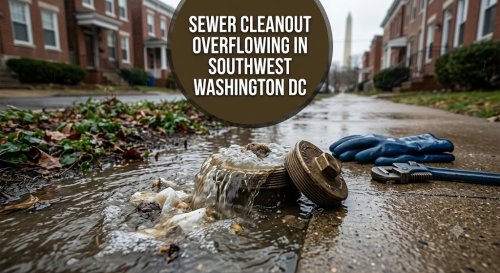
- Cleanouts
- Other low-level plumbing fixtures
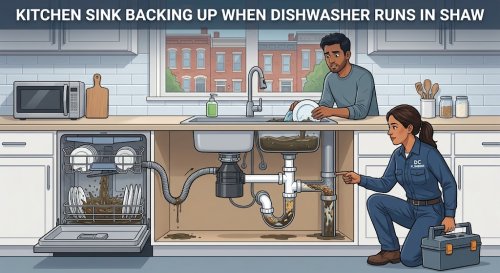
A small fixture clog is not necessarily a sewer backup. For example, a kitchen sink that drains slowly may have a localized blockage. But if the basement toilet, shower, and floor drain all begin backing up together, the problem is likely farther downstream.
A sewer backup plumber investigates whether the obstruction is inside the building, in the private sewer lateral, or associated with the public sewer.
Why Do Sewer Backups Happen?
Tree Root Intrusion
Tree roots can enter sewer pipes through cracks, defective joints, or other openings. Once inside, roots can trap waste and restrict wastewater flow.
Grease and Waste Buildup
Grease can accumulate inside sewer piping and collect other debris. DC Water identifies grease buildup and inappropriate materials entering the drainage system among causes of sewer blockages.
Aging or Damaged Sewer Pipes
Older sewer lines can develop cracks, separated joints, corrosion, settlement, or collapse.
Soil Settlement
Changes in surrounding soil can cause pipes to shift or develop low areas where wastewater and debris collect.
Misaligned Pipe Joints
A separated or poorly aligned joint can restrict flow and create an opening for roots or soil.
Collapsed Pipes
A severely deteriorated pipe can partially or completely collapse, preventing normal wastewater flow.
Heavy Rainfall
Heavy rain can increase the amount of water entering or moving through sewer systems. DC Water notes that sanitary sewer overflows can occur during excessive rainfall.
Improper Items Being Flushed
Wipes, paper towels, hygiene products, grease, and other inappropriate materials can contribute to blockages.
Signs You May Have a Sewer Backup Problem
Multiple Drains Back Up at Once
This is one of the strongest warning signs of a main drainage or sewer problem.
Basement Floor Drain Overflows
Because basement drains are often among the lowest fixtures, wastewater may emerge there when the downstream sewer cannot accept additional flow.
Toilets Gurgle
Gurgling can indicate air movement around a restriction.
Sewage Smell
Persistent sewage odors can indicate wastewater or sewer-gas problems.
Slow Drains Throughout the Property
One slow drain may be localized. Several slow drains deserve more attention.
Wastewater Appears After Flushing
If flushing one toilet causes another fixture to back up, the drainage system may have a blockage farther downstream.
Yard Becomes Unusually Wet
A wet or unusually green section of lawn may sometimes indicate an underground sewer leak. It is not proof by itself, but it can be significant when combined with recurring backups.
Problems Become Worse During Heavy Rain
A backup that repeatedly occurs during major storms deserves professional investigation.
What Should You Do During a Sewer Backup?
Stop Using Water
Do not continue showering, flushing toilets, running the washing machine, or using other fixtures if wastewater is backing up.
Additional water can make the backup worse.
Keep People and Pets Away
Sewage may contain disease-causing organisms. Avoid direct contact and keep children and pets away from contaminated areas.
Do Not Touch Electrical Equipment
If sewage or water has reached electrical outlets, appliances, extension cords, or electrical panels, do not enter the area until it is safe.
Move Valuables
If possible, move furniture, boxes, electronics, and other valuables away from the affected area without walking through contaminated water.
Report the Backup to DC Water
DC Water instructs customers to immediately report sewer backups to its 24-hour Water and Sewer Emergency Line at (202) 612-3400.
Contact a Qualified Plumber When Appropriate
If DC Water determines that the public sewer is functioning and the problem is in the private sewer lateral, you may need a registered master plumber to clear and evaluate the line.
How Does a Professional Diagnose a Sewer Backup?
Step 1: Review the Symptoms
The plumber asks when the backup started, which fixtures are affected, whether rain is involved, and whether similar problems have occurred previously.
Step 2: Inspect Accessible Fixtures and Cleanouts
The plumber determines whether the blockage is local or farther downstream.
Step 3: Locate the Blockage
Drain-cleaning equipment may be used to restore enough flow to investigate the pipe.
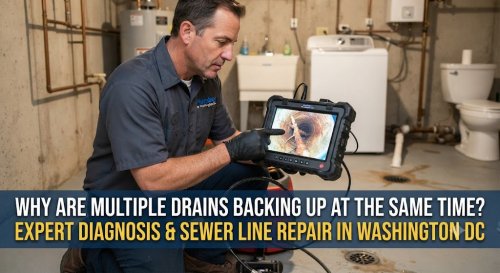
Step 4: Perform a Camera Inspection
A sewer camera can show whether the line contains roots, grease, cracks, separated joints, or a collapsed section.
Step 5: Determine Responsibility
In Washington, DC, the location of the blockage matters. If the problem is in the private sewer lateral, the property owner generally needs to arrange the necessary work. If the blockage is in the public portion, DC Water's procedures apply.
Step 6: Recommend the Appropriate Repair
The solution might involve cleaning, root removal, localized repair, sewer rehabilitation, or replacement.
Step 7: Test the Drainage System
After the work, wastewater flow should be checked to confirm that the blockage has been addressed.
Common Sewer Backup Repair Options
Mechanical Sewer Cleaning
A professional may use a drain cable or other mechanical equipment to break through or remove an obstruction.
This can be effective for certain blockages, but it does not necessarily repair a damaged pipe.
Hydro Jetting
Hydro jetting uses pressurized water to clean appropriate sewer pipes and remove stubborn buildup.
It should not be treated as a universal solution. The pipe's material and structural condition should be considered first.
Root Removal
Mechanical or specialized cleaning may remove roots that have entered the line. However, recurring root intrusion can indicate that the pipe itself needs repair.
Sewer Camera Inspection
A camera inspection helps determine whether the problem is a blockage or structural defect.
Localized Pipe Repair
If only a limited section is damaged, repairing that section may be more appropriate than replacing the entire line.
Sewer Line Replacement
Replacement may be considered when the pipe has extensive deterioration, collapse, repeated failures, or another condition that makes continued cleaning impractical.
Trenchless Sewer Rehabilitation
Some sewer lines may be candidates for trenchless rehabilitation, depending on pipe condition, alignment, access, and the selected method.
Can You Fix a Sewer Backup Yourself?
A homeowner can take emergency precautions, but sewage-related problems are usually not appropriate for extensive DIY repair.
You can safely:
- Stop using water.
- Report the backup to DC Water.
- Keep people and pets away from sewage.
- Move valuables if it is safe.
- Avoid electrical hazards.
- Photograph visible damage.
- Contact an appropriately qualified plumber when the private sewer lateral needs service.
Avoid repeatedly pouring chemical drain cleaners into a sewer backup.
Do not enter an underground sewer, confined space, or excavation.
Do not dig up the sewer lateral yourself without knowing where underground utilities are located and understanding applicable requirements.
What Tools Does a Sewer Backup Plumber Use?
Sewer Cameras
A camera provides a visual inspection of the inside of the sewer pipe.
Drain Cables
Mechanical cables can clear many types of blockages.
Hydro Jetting Equipment
High-pressure water can remove certain grease, sludge, and buildup when the pipe is suitable for the process.
Electronic Pipe Locators
Locators can help determine where underground piping is located before excavation.
Leak Detection Equipment
Specialized equipment may help identify concealed water-related problems.
Trenchless Equipment
Specialized rehabilitation equipment can sometimes repair or renew a suitable underground sewer without traditional full-length excavation.
The equipment should be selected according to the actual pipe condition, not simply because it is available.
How Long Does Sewer Backup Repair Take?
The timeline depends on the cause and location.
Simple Blockage
A straightforward obstruction in an accessible sewer line may be cleared relatively quickly.
Root or Heavy Buildup
Root intrusion or extensive buildup may require more cleaning and inspection.
Damaged Pipe
A cracked, separated, or collapsed pipe requires more extensive work than a simple blockage.
Major Sewer Replacement
Replacement can take significantly longer because it may involve excavation, pipe installation, inspections, permits, utility coordination, and surface restoration.
Emergency service may stop the immediate backup quickly, but permanent repair and property cleanup can take longer.
What Does Sewer Backup Repair Cost in Washington, DC?
There is no responsible fixed price for every sewer backup.
Plumbing repair costs vary depending on the severity of the problem, accessibility, materials required, emergency service, property type, and local labor rates.
Cost factors can include:
- Diagnostic fees
- Sewer camera inspection
- Drain cleaning
- Hydro jetting
- Root removal
- Labor
- Replacement pipe
- Excavation
- Trenchless equipment
- Emergency or after-hours charges
- Permits
- Inspection requirements
- Landscaping restoration
- Sidewalk or pavement restoration
- Water extraction and cleanup
A simple blockage is fundamentally different from a collapsed sewer lateral underneath a driveway.
Ask the plumber what the estimate includes and whether additional work requires approval.
Hidden Truths Homeowners Should Know
A Backup Is Not Always Caused by Your Private Pipe
The public sewer may be involved. This is why DC Water recommends reporting a sewer backup before assuming the private lateral is responsible.
Cleaning the Pipe Does Not Always Fix the Problem
If roots, cracks, settlement, or collapse are causing repeated blockages, cleaning may only restore flow temporarily.
Small Recurring Backups Are a Warning
A line that backs up every few months should be investigated rather than repeatedly cleared without determining the cause.
Sewer Cleanup Is Different From Drain Cleaning
Removing the blockage is only one part of the problem. Contaminated areas may require professional water-damage and sanitation cleanup.
Insurance Coverage Varies
DC Water states that cleanup and damages from sewer backups are most often the property owner's responsibility and recommends considering appropriate insurance coverage or a policy rider.
Backwater Valves Can Provide Protection
A properly functioning backwater valve can help prevent wastewater from entering a building during certain sewer surcharges or backups. DC Water has a backwater-valve program with eligibility requirements.
A Low Price Does Not Tell You the Whole Story
A quote that excludes camera inspection, excavation, restoration, or emergency charges may not actually be the least expensive option.
Repeated Root Problems May Require More Than Root Removal
If roots repeatedly enter the same pipe, investigate the pipe defect allowing them inside.
15 Common Mistakes Homeowners Make
1. Continuing to Use Water
Every additional gallon can worsen an active backup.
2. Ignoring a Slow Drain
Repeated slow drainage can precede a larger blockage.
3. Using Chemical Drain Cleaners
Chemical products may not resolve a deep sewer obstruction and can create additional handling concerns.
4. Flushing Wipes
Wipes can contribute to blockages and should generally be disposed of in the trash.
5. Pouring Grease Into Drains
Grease can accumulate and restrict sewer flow.
6. Assuming the Private Sewer Is at Fault
Always determine whether the public sewer is involved.
7. Waiting Until Sewage Reaches the Living Area
A recurring basement backup deserves attention before it becomes a larger event.
8. Repeatedly Snaking the Same Line Without Inspection
If the clog keeps returning, determine why.
9. Hiring an Unqualified Plumber
Use an appropriately licensed professional for regulated plumbing work.
10. Choosing a Contractor Only on Price
Compare the diagnosis, equipment, scope, materials, and restoration requirements.
11. Entering Contaminated Water
Avoid direct contact with sewage.
12. Ignoring Electrical Hazards
Never enter standing water near electrical equipment.
13. Failing to Document Damage
Photographs can help when discussing damage with an insurer or contractor.
14. Forgetting About Preventive Protection
Properties with previous backups may benefit from evaluating backwater protection.
15. Assuming Every Backup Requires Sewer Replacement
A professional inspection may reveal a simple blockage or localized defect instead.
Sewer Backup Maintenance Tips
- Keep grease out of drains.
- Do not flush wipes.
- Dispose of hygiene products properly.
- Use drain screens where appropriate.
- Address recurring slow drains promptly.
- Keep accessible sewer cleanouts clear.
- Learn where your main shutoff is located.
- Monitor basement drains during heavy rain.
- Watch for recurring toilet gurgling.
- Pay attention to sewage odors.
- Inspect visible plumbing for leaks.
- Keep records of previous sewer repairs.
- Consider a sewer camera inspection when backups recur.
- Ask about root management if trees are near sewer routes.
- Avoid planting large trees directly over known sewer lines.
- Ask a plumber whether a backwater valve is appropriate.
- Check DC Water's current backwater-valve program if your property has experienced a documented backup.
- Keep valuables elevated in a basement with a history of flooding.
- Have older sewer piping evaluated when problems become recurrent.
- Report sewer backups to DC Water promptly.
DC Water states that a properly functioning backwater valve allows wastewater to flow outward while helping prevent sewage from entering the building during certain sewer surcharges or backups.
When Should You Call an Emergency Plumber?
A sewer backup should be treated as urgent when wastewater is entering the property or multiple fixtures are affected.
Call for emergency plumbing assistance when you have:
- Sewage entering a basement
- Wastewater coming through a floor drain
- Multiple toilets or drains backing up
- A collapsed or severely blocked sewer line
- A major sewage overflow
- Flooding combined with wastewater
- A backup that is rapidly getting worse
- A recurring backup during heavy rainfall
- A suspected broken sewer pipe
- Contaminated water entering living or business areas
For an active sewer backup in Washington, DC, contact DC Water first at (202) 612-3400. DC Water's guidance specifically asks residents to report the backup so the public sewer can be checked.
If DC Water determines the main sewer is clear, a registered master plumber may be required to clear the private sewer lateral.
People Also Ask About Sewer Backups
What should I do first if my sewer backs up?
Stop using water, keep people away from wastewater, avoid electrical hazards, move valuables if safe, and report the backup to DC Water at (202) 612-3400.
Why does my basement floor drain keep backing up?
A recurring basement backup may be caused by a blocked sewer lateral, tree roots, grease, pipe damage, settlement, or a public sewer problem.
How do I know if the sewer backup is my responsibility?
The location of the blockage matters. DC Water should be contacted first to determine whether the public sewer is affected.
Can heavy rain cause a sewer backup?
Yes. Excessive rainfall can increase flows in sewer systems and contribute to overflows or backups under certain conditions.
Can tree roots cause sewer backups?
Yes. Roots can enter defective sewer pipes and restrict wastewater flow.
Can a clogged sewer line damage my house?
Yes. Wastewater can damage flooring, drywall, furnishings, and other building materials while also creating sanitation concerns.
Is hydro jetting safe for old sewer pipes?
It depends on the pipe's material and structural condition. A professional should evaluate the pipe before selecting high-pressure cleaning.
Do I need a sewer camera inspection?
It is particularly useful when a backup is recurring, the blockage returns after cleaning, or structural damage is suspected.
How much does sewer backup repair cost?
Costs vary according to the cause, location, accessibility, labor, equipment, emergency service, pipe condition, and whether repair or replacement is required.
Can a backwater valve prevent sewer backups?
A properly working backwater valve can help prevent wastewater from entering a building during certain sewer surcharges and backups, but it is not a guarantee against every type of plumbing or flooding problem.
Who pays for sewer backup cleanup in Washington, DC?
DC Water states that cleanup and damages are most often the property owner's responsibility. Insurance coverage depends on the individual policy and circumstances.
Should I replace my sewer line after one backup?
Not necessarily. One backup may be caused by a removable obstruction. Replacement should be considered only after the actual condition and cause of the sewer problem are evaluated.
Voice Search Questions About Sewer Backups
“Who do I call for a sewer backup in Washington, DC?”
Call DC Water's 24-hour Water and Sewer Emergency Line at (202) 612-3400 to report the backup and determine whether the public sewer is involved.
“What should I do if sewage is coming up through my basement drain?”
Stop using water, stay away from contaminated wastewater, avoid electrical hazards, and report the backup to DC Water immediately.
“Can a plumber fix a sewer backup?”
Yes, when the problem is in the private sewer lateral or plumbing system. The plumber can diagnose and clear the blockage and determine whether pipe repair or replacement is necessary.
“How can I prevent my basement from flooding with sewage?”
Proper drain maintenance, correcting recurring sewer problems, and evaluating a suitable backwater valve can reduce risk. DC Water has specific information and eligibility requirements for its backwater-valve program.
How to Choose the Right Sewer Backup Plumber
When hiring a plumber for a sewer backup, ask:
- Is the plumber appropriately licensed?
- Do they handle sewer lateral problems?
- Will they determine the blockage location before recommending replacement?
- Is camera inspection available?
- What cleaning method is recommended?
- Can they explain whether roots or pipe damage are involved?
- Are emergency charges disclosed?
- Does the estimate include the necessary equipment?
- Will the sewer be tested after cleaning or repair?
- If the blockage is in public space, will the required report be filed with DC Water?
In Washington, DC, these questions are particularly important because responsibility can change depending on where the blockage is located. DC Water states that plumbers must file a report when they discover a blockage in the public portion of a sewer lateral.
Avoid a contractor who recommends complete sewer replacement without explaining what the inspection found.
Why Choose Plumber in Washington DC?
When a sewer backup occurs, you need a plumbing company that understands that the immediate priority is controlling the problem and identifying its actual cause.
Plumber in Washington DC provides plumbing services for homeowners and businesses in Washington, DC.
For plumbing service inquiries, contact (844) 833-2093.
You can also visit Plumber in Washington DC to learn more about the company's plumbing services.
Washington, DC properties vary considerably across neighborhoods such as Capitol Hill, Georgetown, Dupont Circle, Shaw, Petworth, Columbia Heights, Brookland, and Anacostia. Older homes can have different sewer configurations and pipe conditions than newer apartments or commercial properties.
If you are comparing plumbers serving nearby communities such as Arlington, Alexandria, Silver Spring, or Bethesda, confirm the contractor's service area and applicable licensing before scheduling major work.
Final Thoughts
A sewer backup is more than an inconvenient clogged drain. It can quickly become a sanitation and property-damage problem.
The safest response is to stop using water, keep people away from wastewater, avoid electrical hazards, and report the backup to DC Water at (844)-833-2093. The utility can determine whether the public sewer is affected.
If the public sewer is clear and the problem is in the private sewer lateral, a qualified plumber can inspect the line, clear the obstruction, and determine whether the underlying cause requires cleaning, root removal, repair, rehabilitation, or replacement.
For recurring backups, do not settle for repeatedly clearing the same blockage without asking why it keeps happening. A proper diagnosis can help you make a more informed decision and avoid paying repeatedly for temporary solutions.
For professional plumbing assistance in Washington, DC, contact Plumber in Washington DC at (844) 833-2093