Lead Service Lines in Washington, DC: What Homeowners Should Know
Learn what Washington, DC homeowners should know about lead service lines, including identification, health concerns, testing, replacement options, costs, and DC Water resources.


Lead Service Lines in Washington, DC Homes: What Homeowners Should Know
Lead service lines are an important concern for owners of older homes in Washington, DC. A service line is the pipe that carries drinking water from the public water main to a property. In some older properties, that pipe may contain lead.
The issue matters because lead can enter drinking water when plumbing materials containing lead corrode or deteriorate. Lead exposure is particularly concerning for children and pregnant people.
If you live in an older Washington, DC property, don't assume your service line is lead simply because the home is old. The safest approach is to determine what material serves your property and follow current guidance from DC Water and the District.
What Is a Lead Service Line?
A lead service line, often abbreviated LSL, is a water-supply pipe made from lead that connects a building to the public water distribution system.
The service line can include different sections depending on how the property was constructed and how the water connection was installed.
A property may have:
- A lead service line
- A copper service line
- A galvanized steel service line
- A plastic service line
- A partially replaced or mixed-material service line
- An unknown service-line material
This distinction matters because a property can have lead-containing plumbing even when the visible pipes inside the house are made from another material.
Why Are Lead Service Lines a Concern?
Lead can enter drinking water when lead-containing plumbing materials corrode.
The amount of lead that enters water can vary depending on factors such as:
- Water chemistry
- Pipe condition
- Water stagnation
- Temperature
- Plumbing materials
- Corrosion-control conditions
- How long water remains in contact with plumbing
You cannot reliably determine whether water contains lead based on its appearance, taste, or smell.
That is why identifying the service-line material and following appropriate water-testing guidance are important.
Which Washington, DC Homes May Have Lead Service Lines?
Older properties deserve particular attention because lead and other older plumbing materials were historically used in water-supply systems.
However, the age of a house alone does not prove that it has a lead service line.
Washington, DC has undertaken programs to identify and replace lead service lines. DC Water provides information and resources for residents who want to determine their service-line material and understand replacement options. (dcwater.com)
If you are buying or renovating an older property, determining the service-line material can be an important part of understanding the plumbing system.
How Can You Tell If Your Service Line Contains Lead?
Check DC Water Resources
Start with current information available from DC Water.
The utility provides lead-service-line information and resources for District residents. (dcwater.com)
Because service-line records and replacement programs can change, use current utility information rather than relying on an old property listing or a previous owner's assumption.
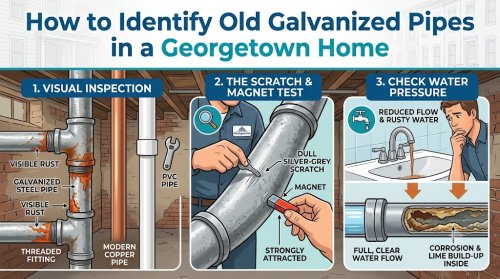
Look at the Exposed Pipe
If the service line is visible where it enters the building, its material may provide a clue.
However, identifying pipe material based only on appearance can be difficult.
Lead pipe is generally:
- Gray in appearance
- Relatively soft
- Nonmagnetic
- Easy to scratch compared with steel
Do not scrape, cut, or aggressively disturb a suspected lead pipe simply to identify it.
If you're unsure, have a qualified professional evaluate it.
Look for a Mixed-Material Connection
Some properties have more than one plumbing material.
For example, a lead service line may connect to copper plumbing inside the property.
Seeing copper pipes under your sink does not necessarily prove that the service line from the street is also copper.
Is Lead in the Water Visible?
No.
Lead dissolved in drinking water is not something you can reliably detect by looking at the water.
Water containing lead may look completely normal.
It may also have no unusual taste or smell.
That is why visual inspection alone cannot determine whether drinking water contains lead.
If you are concerned about lead exposure, use appropriate water-testing and follow current guidance from DC Water and local health authorities.
What Are the Health Concerns Associated With Lead?
Lead exposure can affect the nervous system and other body systems.
Children are particularly vulnerable to the effects of lead exposure, and pregnancy is another important period when lead exposure deserves special attention.
The U.S. Environmental Protection Agency and CDC provide extensive information about lead in drinking water and potential health effects.
For health-specific questions or concerns about exposure, consult a qualified healthcare professional rather than relying on a plumbing inspection alone.
Does Having a Lead Service Line Mean the Water Is Unsafe?
Not necessarily.
The presence of a lead service line does not tell you exactly how much lead, if any, is present in your drinking water at a particular moment.
Lead levels can vary based on water chemistry, plumbing conditions, and how long water has been sitting in the pipes.
The important point is that you should not assume the water is either safe or unsafe solely from the appearance or age of the pipe.
Follow current testing and risk-reduction guidance.
What Can Homeowners Do to Reduce Potential Lead Exposure?
Use Fresh Water for Drinking and Cooking
If water has been sitting in household plumbing for several hours, flushing stagnant water can reduce the amount of time water has been in contact with plumbing materials.
The exact flushing procedure can depend on the property and local guidance.
Use Cold Water for Consumption
Use cold tap water for drinking and cooking rather than hot tap water.
Heating water does not make lead-containing water safer.
Clean Faucet Aerators
Sediment and particles can collect in faucet aerators.
Cleaning them according to manufacturer instructions can help maintain normal water flow and reduce accumulated debris.
Follow Local Guidance
Washington, DC residents should follow current DC Water recommendations rather than relying on generic internet advice.
DC Water's Lead Free DC program provides information about lead service lines, testing, replacement, and available resources. (dcwater.com)
Should You Replace a Lead Service Line?
If a property has a confirmed lead service line, replacement is the long-term solution for removing that lead pipe from the drinking-water service connection.
The exact process depends on:
- Who owns the relevant portion of the service line
- Location of the line
- Property type
- Existing plumbing
- Replacement program eligibility
- Required permits
- Street or sidewalk access
- Current DC Water programs
Do not assume that a private plumber should immediately excavate the line.
First determine whether the service line has already been identified and whether DC Water has a program or process that applies to your property.
What Is Lead Service Line Replacement?
Lead service-line replacement generally involves removing the lead-containing service pipe and installing an approved replacement material.
The work may involve access to:
- The street
- Sidewalk
- Property line
- Building foundation
- Basement
- Utility room
- Interior plumbing connection
Because service lines can cross public and private property, replacement may require coordination between the property owner, DC Water, contractors, and applicable District authorities.
What Does Professional Lead Service-Line Work Involve?
Step 1: Identify the Service-Line Material
The first objective is determining whether the service line is lead, galvanized steel, copper, plastic, or another material.
Step 2: Determine Responsibility
The plumber or utility representative can help establish which portion of the service connection is private and which falls under utility responsibility.
Step 3: Review Available Programs
Check current DC Water resources to determine whether your property qualifies for a replacement program or other assistance.
Step 4: Plan the Replacement
If replacement is appropriate, the work is planned around property access, existing plumbing, utility connections, permits, and restoration requirements.
Step 5: Complete the Replacement
The lead-containing service line is removed or replaced according to applicable requirements.
Step 6: Test and Verify
The completed plumbing connection should be checked for leaks and proper operation.
Can a Homeowner Replace a Lead Service Line?
Lead service-line replacement is not a typical DIY plumbing project.
It may involve:
- Excavation
- Public-right-of-way requirements
- Water-main connections
- Permits
- Specialized equipment
- Plumbing-code requirements
- Coordination with the water utility
- Street or sidewalk restoration
Attempting to modify a service line without proper authorization can create safety, regulatory, and water-quality problems.
For significant plumbing work, use appropriately licensed professionals and follow DC Water requirements.
How Much Does Lead Service-Line Replacement Cost?
There is no reliable one-price answer.
The cost can depend on:
- Length of the service line
- Location
- Depth
- Excavation requirements
- Sidewalk or street access
- Property construction
- Replacement material
- Labor
- Permits
- Restoration
- Utility coordination
- Program eligibility
- Whether other plumbing needs replacement
A homeowner should also determine whether DC Water offers assistance or replacement options before paying for private work.
How Long Does Replacement Take?
A straightforward private-side project may be relatively quick once planning and approvals are complete.
More complicated projects can take longer because they may require:
- Utility coordination
- Permits
- Excavation
- Street or sidewalk access
- Inspection
- Restoration
The actual schedule depends on the property and current District requirements.
Hidden Truths Homeowners Should Know
Copper Pipes Inside the Home Don't Prove the Service Line Is Lead-Free
The service line outside the house can be made from a different material.
You Can't See Lead in Drinking Water
Normal-looking water can still contain contaminants.
Pipe Age Is Only a Clue
A property's construction date does not prove the service-line material.
Replacement Is Different From Repair
If the concern is lead exposure, covering or repairing a small section of pipe does not necessarily remove the lead service line.
Utility and Private Responsibilities Can Differ
The portion of the service connection owned or controlled by the utility may be handled differently from the portion on private property.
Current Information Matters
Lead-service-line replacement programs, eligibility rules, inventories, and assistance can change. Always check current DC Water information before making a major decision.
15 Common Mistakes Homeowners Make
1. Assuming an Older Home Definitely Has Lead
Age alone isn't proof.
2. Assuming a Newer Home Definitely Does Not
Construction records and plumbing history matter.
3. Judging Water Safety by Appearance
Lead cannot be reliably detected by sight, taste, or smell.
4. Scraping a Suspected Lead Pipe
Do not disturb suspected lead-containing plumbing unnecessarily.
5. Replacing Only Visible Indoor Plumbing
The service line between the building and street may be a separate concern.
6. Hiring a Contractor Before Checking DC Water
There may be utility resources or programs worth investigating first.
7. Assuming All Service Lines Are the Same Material
Mixed-material plumbing systems are possible.
8. Ignoring Water Testing
If lead exposure is a concern, appropriate testing can provide useful information.
9. Using Hot Tap Water for Drinking
Use cold water for drinking and cooking.
10. Assuming Boiling Removes Lead
Boiling water does not remove lead and can increase the concentration if water evaporates.
11. Treating a Filter as a Permanent Pipe Replacement
A certified filter can be a risk-reduction measure, but it does not remove a lead service line.
12. Relying on Old Property Records Alone
Records may not always reflect subsequent plumbing modifications.
13. Ignoring Galvanized Pipe Connections
Galvanized plumbing can be part of a service-line configuration and should be properly identified.
14. Starting Excavation Without Authorization
Service lines may cross public property and require coordination.
15. Delaying Professional Evaluation When the Pipe Is Damaged
A damaged service line can create water loss and property damage in addition to the concern about pipe material.
Maintenance and Risk-Reduction Tips
Homeowners can take several practical steps:
- Learn what material your service line is made from.
- Check current DC Water service-line information.
- Keep records of plumbing replacements.
- Inspect accessible plumbing periodically.
- Clean faucet aerators.
- Use cold water for drinking and cooking.
- Flush stagnant water according to current local guidance.
- Consider appropriate certified water filtration if recommended.
- Follow manufacturer instructions for water filters.
- Replace filters on schedule.
- Watch for unusual water discoloration.
- Monitor changes in water pressure.
- Investigate unexplained water usage.
- Repair leaking plumbing promptly.
- Avoid disturbing suspected lead pipes.
- Ask questions before major plumbing renovations.
- Check whether your property qualifies for current replacement programs.
- Use appropriately licensed plumbing professionals.
- Keep documentation of service-line inspections.
- Follow DC Water and District health guidance.
When Should You Contact a Plumber?
Consider professional assistance if:
- You cannot identify your service-line material.
- You suspect the service line contains lead.
- The service line is leaking.
- You have recurring water-pressure problems.
- You see significant corrosion.
- You need to replace private-side plumbing.
- You are renovating an older property.
- You need help distinguishing the service line from interior plumbing.
If you have an active water leak, shut off the water if it is safe to do so and seek prompt plumbing assistance.
For utility-side concerns, contact DC Water directly rather than assuming a private plumber is responsible.
People Also Ask About Lead Service Lines
How do I know if my Washington, DC home has a lead service line?
Check available DC Water information and inspect accessible portions of the service connection without disturbing the pipe. A qualified professional can help identify the material when it is not obvious.
Are lead service lines still found in Washington, DC?
Older service lines containing lead have existed in the District, and DC Water has an ongoing program focused on identifying and replacing lead service lines. Check the current Lead Free DC resources for the latest information. (dcwater.com)
Can I tell if water contains lead by looking at it?
No. Lead contamination is not reliably visible, and water containing lead may look completely normal.
Does a water filter remove lead?
Some filters are certified to reduce lead, but not all filters do so. Look for appropriate independent certification and follow the manufacturer's replacement instructions.
Does boiling water remove lead?
No. Boiling does not remove lead from water.
Should I replace my lead service line?
If a lead service line is confirmed, replacement is the long-term approach to removing the lead pipe. However, homeowners should first determine whether DC Water has a replacement program or process that applies to their property.
Are lead pipes the same as galvanized pipes?
No. They are different materials. However, galvanized steel can also be part of older service-line systems and can present its own plumbing concerns.
Can lead service lines cause low water pressure?
A lead service line itself does not automatically mean low pressure. However, an old or deteriorated service line can contribute to flow restrictions or leaks.
Who is responsible for replacing a lead service line in Washington, DC?
Responsibility depends on the location and ownership of the relevant portion of the service connection and the applicable DC Water program or requirements. Check directly with DC Water for your property.
Can a plumber test my water for lead?
A plumber may be able to help with plumbing assessment and recommend appropriate testing, but water-quality testing should follow appropriate laboratory and public-health guidance.
Is a lead service line an emergency?
The presence of a lead service line is generally not the same type of emergency as a burst pipe or active flood. However, concerns about drinking-water exposure should be addressed promptly using current utility and health guidance.
How to Choose a Plumber for Lead Service-Line Work in Washington, DC
If you need professional assistance, choose a plumber who understands that lead service-line work involves more than ordinary pipe repair.
Ask:
- Are you appropriately licensed for this work?
- Can you identify the existing service-line material?
- Will you coordinate with DC Water when required?
- Are permits necessary?
- What portion of the service line will be replaced?
- What replacement material will be used?
- Will excavation be required?
- Who handles sidewalk or surface restoration?
- Are there current DC Water replacement programs?
- What will the estimate include?
Avoid contractors who pressure you into immediate excavation without first establishing what material you have and who is responsible for the relevant section.
Why Choose plumberinwashingtondc?
For homeowners and property owners in Washington, DC who need help evaluating older water-service plumbing, plumberinwashingtondc can discuss inspection and repair options.
Before authorizing significant work, ask for a clear explanation of the suspected plumbing material, recommended work, expected timeline, and applicable costs. For substantial plumbing work, verify that the professional performing the work is appropriately licensed and that required utility coordination or permits are addressed.